From audit to improvement
Step 1- Understand your service.
We begin by understanding your ultrasound service, the examinations you perform and what you want to achieve. Together, we agree the local and national protocols used, audit scope, relevant clinical criteria, case selection and reporting requirements.
Whether you want to review an individual sonographer or understand performance across a team, the approach is tailored to your needs.
Step 2- Review images and reports
Experienced clinical reviewers assess selected ultrasound images and reports using structured audit criteria.
The review considers image acquisition, anatomical coverage, measurements and reporting, helping identify strengths, areas for development and findings that require closer attention.
Step 3-Turn findings into insight
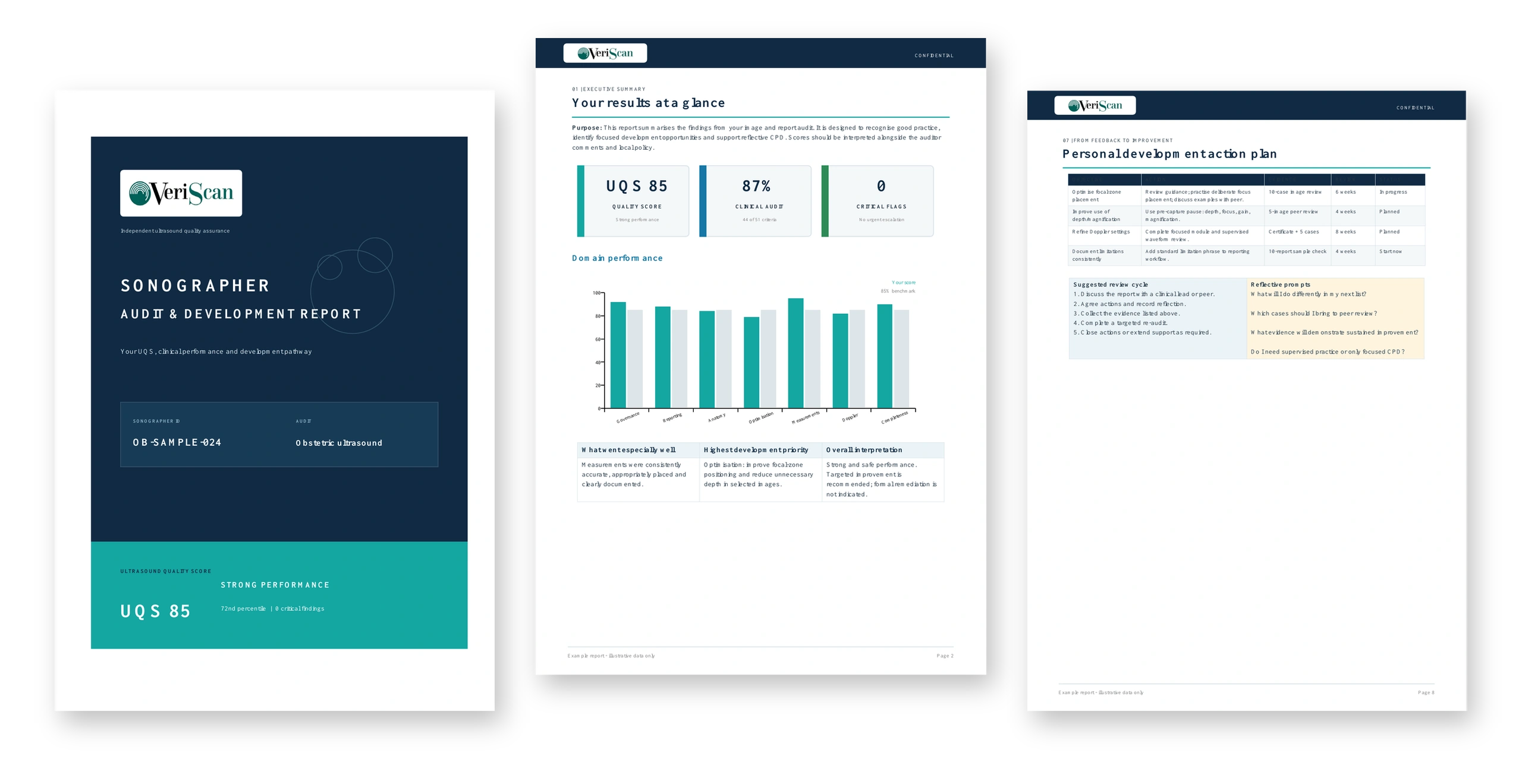
Your results are presented in a clear report, bringing together scores, clinical observations and practical recommendations.
Individual and service-level findings help you understand where performance is strong, where variation exists and which improvements should take priority.
Step 4- Turn findings into insight
Your results are presented in a clear report, bringing together scores, clinical observations and practical recommendations.
Individual and service-level findings help you understand where performance is strong, where variation exists and which improvements should take priority.
What you receive
A clear audit report showing what was reviewed, the findings and recommended next steps. Depending on the agreed scope, this may include individual feedback, team summaries, domain scores and trends over time.
The aim is to give both clinicians and service leads information they can understand and use.
More than a score
A score provides a useful summary, but the detail behind it matters. VeriScan brings together image quality, clinical completeness and reporting findings to explain where improvement is needed.
Important concerns are highlighted separately, so they remain visible alongside the overall result.
Feedback that supports development
Our approach is constructive and focused on learning. We recognise good practice while identifying specific opportunities to improve.
Clear feedback helps make development conversations more focused and training more relevant to the individual or team.
A view of quality across your service
Individual reviews can reveal wider patterns. Looking across audited cases helps identify recurring strengths, shared training needs and variation within a service.
These insights can support clinical governance discussions and help leaders prioritise improvement.
Review. Act. Review again.
Quality assurance is an ongoing process. Acting on findings and repeating audit helps you understand whether changes are making a difference.
Over time, this creates a clearer picture of performance and progress.
Ready to discuss your service?
Tell us about your team, the examinations you perform and what you would like to understand. We can help you define an appropriate audit scope and next steps.